


OVERVIEW
The purpose of the IE Diagnostic is to establish the System’s capability to work together with shared objectives and rewards to develop profitable growth, underpinned by the capability to develop segmentation, revenue management and route to market linked to in-outlet execution
The IE Diagnostic is designed to provide the markets with an efficient approach to assessing capabilities. To achieve this, the following approach is recommended:
- Teams from the Bottler and the Company should complete the IE Diagnostic , identifying areas of capability development, the priority in which they need to be addressed and the reasons for this belief.
- Having completed the IE Diagnostic, along with views on gaps and priorities supplied by evidence, the Bottler and the Company should meet to share their conclusions. As a result, success could be defined as:
- Achieving an aligned and agreed set of priority gaps to address.
- Identifying first steps to close these gaps to improve performance.
- Improving business performance based on integrated execution focused actions.
SCORING
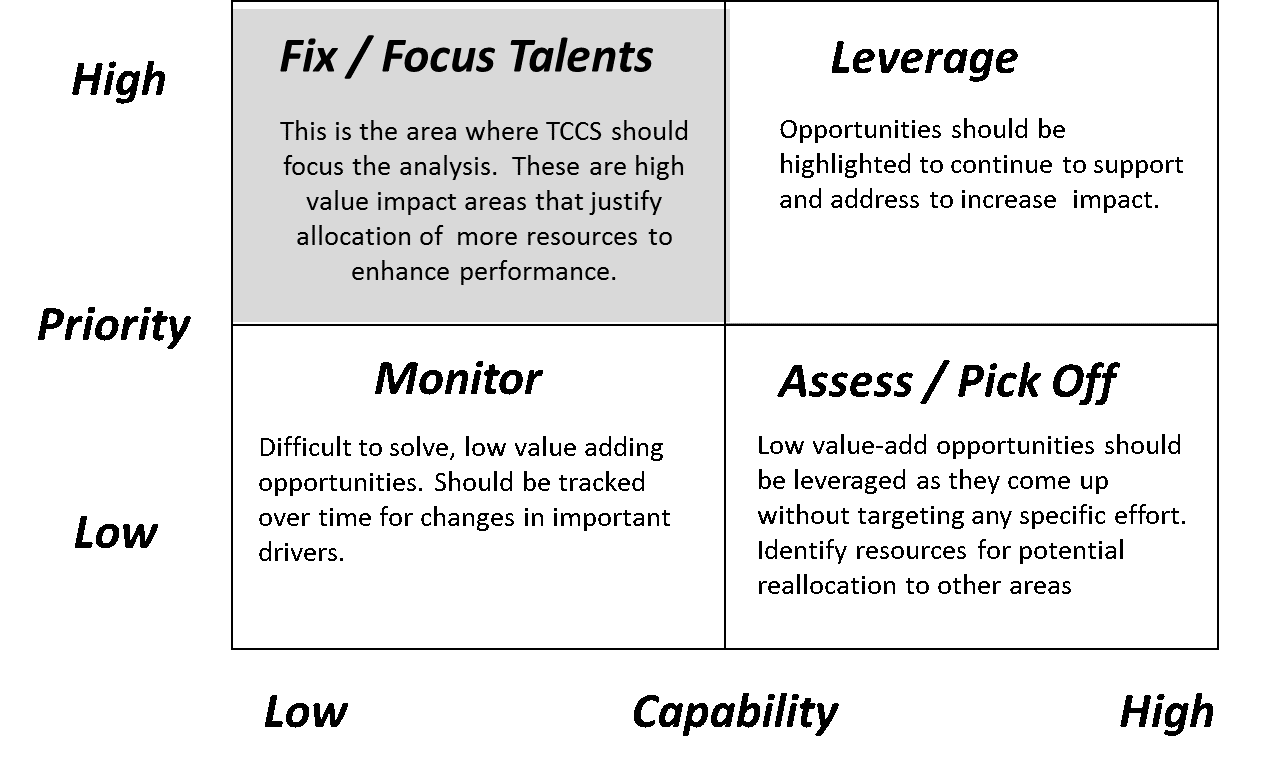
The IE Diagnostic should be scored against the following rating:
Capability (1-Low 4-High) and Priority (1-Low 4-High) To Address
The Evidence Box provided gives you the opportunity to provide feedback on
the key reasons for your scores which will be vital in workshop discussions
It is comprised of 40 key areas split into 4 sections as follows:
- REVENUE GROWTH MANAGEMENT
- SEGMENTATION
- ROUTE TO MARKET
- RIGHT EXECUTION DAILY
3 STRATEGIC MANDATES
- Deploy In-house Tools: System tools supported by IT Data Analytics Platform to scale, lower costs and learn together
- Future tools development with Field Validation: alignment and direction from Steering Commiteee
- Maintain Transparency on algorithm: We will own our IP ... glass box instead of black box
BUSINESS REFERENCE
RATIONALE
IE DIAGNOSTIC – RATIONALE – EVERY DRIVER IS FILTERED BY A SELECTION CRITERIA
“Operationalizing” IE DIAGNOSTICS – RGM / SEG / RTM / RED – To be maximally useful, business drivers must exhibit four key characteristics
-
1. Measurability- The degree to which drivers can be measured – or directionally help identify size of prize
- Symmetry – Are the 10 drivers balanced among themselves (eg inside RGM) and vs the other areas (eg relative to RTM)?
- Mutually Exclusive & Completely Exhaustive - Are the 10 drivers different & sufficient to explain each area (RGM / SEG / RTM / RED)?
-
2. Substantiality - The degree to which drivers are large enough and different on true, meaningful characteristics
- A driver should be worth going after with a tailored program
-
A driver should be stable and reproducible – ie a driver should display sensitivity across various characteristics:
- Over time across different operations – eg urban vs rural; modern vs traditional trade; developed vs developing markets, etc
- Over alternative measures – eg competition, category, consumer, channel, customer, etc
-
3. Accessibility - The degree to which the drivers can be effectively reached and addressed
- Can drivers be targeted using readily identifiable characteristics?
-
4. Actionability The degree to which effective programs can be developed & executed for addressing the drivers (i.e., “operationalizing” IE Solutions)
- Does the driver provide insights and opportunities for making the business more profitable? Do drivers help identify solutions – directionally?
GLOSSARY
IE DIAGNOSTIC – SUMMARY DEFINITIONS
-
RGM – Revenue Growth Management – RGM Integrates OM; OBPPC; PTC; PS/TS.
- OM – Opportunity Mapping - Prioritizes growth opportunities based on consumer and shopper needs and market dynamics. Goals: Identify Strategic Brand/ Pack/ Channel Corridors to Focus & Grow; Identify Long-Term Consumer Drivers.
- OBPPC – Occasion, Brand, Price & Pack by Channel - Differentiates offering across channels creating a unique portfolio proposition for the channel focused on specific shopper/ consumer occasions. Goals: Optimize Competitive Pricing Strategy; Identify Price / Volume Engagement Rules vs Competition.
- PTC – Pricing, Terms and Conditions - Approach of managing the total price, discounts and allowances with our customers. Goals: Identify Tiered Pricing to mitigate Cross-Channel Cannibalization; Optimize SKUs and Segmented Assortment
- PS / TS – Promotional Spend / Trade Spend - Investment to the Trade or to the consumer in order to stimulate demand for our products. Goals: Analyze Promo / Trade Spend Effectiveness – Promo Impact on Pricing, Hang-over effects; Identify Promos Contribution Margin & ROI.
-
Segmentation
- The degree to which drivers are large enough and different on true, meaningful characteristics
-
RTM/C – Route-To-Market / Route-To-Consumer
- Establishes customer service systems for optimal sales, logistics and in-field execution. Enables profitable growth through the segmented execution of PicOS at the point-of-purchase. Informs system’s commercial plans to optimize segmented services and customers cost-to-serve.
-
RED – Right Execution Daily
- Development and Deployment of PicOS - from insights and strategy to field execution; Capability process to set, measure, track and tailor activities to enhance business performance; Provides one common language and standard metrics to obtain continuous improvement across operations.
-
OOS
- Out-Of-Stocks – Root-causes may be related ordering process, merchandising, forecasting, inventory management, delivery and returns.
-
OTIF
- On-Time-In-Full – Applicable to sales, merchandising and delivery services characteristics.
-
System
- The Coca-Cola Company and Bottlers
ACKNOWLEDGMENT TO CONTRIBUTORS IN THIS JOURNEY
SPONSORS
- Brian Smith, Monica Hayes, Elaine Bowers-Conventry
BUSINESS REFERENCE
LATAM
- South Latin - Luisa Ortega, Romero Moura, Pablo Teobaldo, Thiago Santos, Mariana Torreguitar
- Latin Center - Larry Rampersad, Susana Goitia
- Brazil + Digital - Minas Vourodimos, Marcelo Bozzini, Antonio Viveiros
APAC + BIG
- Asean - Claudia Lorenzo, Bianca Bourbon, Laura Stubblefield, Sandeep Nicholson, Ning Cao
- BIG - Barry O’Connell, Eric Tan, Federico Tomaszewski, Ian Murdock, Manrique Cerdas, Norman Villalobos
CCNA
- US + Digital - Alex Clarke, Sally Forsyth, Matt Tarallo, Jose Ramirez, Vicente Vallejo
- Canada - Darlene Nicosia, Angie Balian, Cam Erwin, Sue Lynne, Robb Tindale, Michelle Gauci, Tara Scott
EMEA
- Sedef Salingan, Bruno Pietracci, François Herve, Helen Tsendou, Erol Hullu, Oliver Soto, Damiano Marabelli, Alfonso Arce, Kenneth Kamulegeya, Mark Cockcroft, Lungile Mbatha, Isvari Naidoo, Angelina Di Stefano, Samuel Muhindi, Wolfgang Weixelbaumer, Servio Calvo, Ebrahim Goga
TECHNICAL TEAM
- Ali Barodawala, Ankur Chhabra, Vladimir Georgiev, Galina Voloshyna